AI Functions for AI and IoT Oil & Gas Upstream Operations
Petrovia AI delivers enterprise AI and IoT software specifically engineered for exploration, drilling, wellsite, offshore systems, and production field workforce location analytics, E&P access management, drilling equipment tracking, OCTG inventory optimization, downhole tool visibility, and oilfield traceability.
Contact Engineering TeamEnterprise AI and IoT Software for Oil & Gas Upstream Operations
Oil and gas upstream operations represent some of the most operationally demanding environments within the Energy & Utilities Industry. Exploration campaigns, seismic surveys, land drilling, offshore drilling, directional drilling, horizontal drilling, well completion, hydraulic fracturing support, intervention activities, and production support all require accurate coordination of highly skilled personnel, specialized drilling equipment, mobile assets, tubular inventories, contractors, and field logistics operating across geographically dispersed locations.
Maintaining operational visibility across drilling rigs, offshore systems, remote well pads, exploration camps, pipe yards, maintenance workshops, regional warehouses, and production support facilities has become increasingly challenging as upstream operations expand into more remote and technically complex environments. Traditional manual reporting methods often struggle to provide timely operational awareness, making it difficult to locate critical drilling assets, coordinate contractors, optimize workforce deployment, and maintain accurate inventory records throughout the drilling lifecycle.
Petrovia AI addresses these operational challenges through enterprise AI and IoT software specifically engineered for upstream exploration and production workflows. Rather than functioning as a generic industrial tracking solution, the software combines industrial identification technologies with AI to transform workforce identification events, equipment movement, inventory transactions, and authorized access records into actionable operational analytics that improve planning, operational efficiency, regulatory compliance, and decision support.
The solution emphasizes Identification and Location Solutions across upstream operations. Personnel, drilling equipment, downhole tools, drill pipe, casing, tubing, production equipment, mobile vehicles, and warehouse inventory are continuously identified, located, and analyzed using industrial identification technologies without relying on manual reconciliation processes.
AIoT Identification and Location Solutions for Upstream Oil & Gas Operations Enterprise Illustration
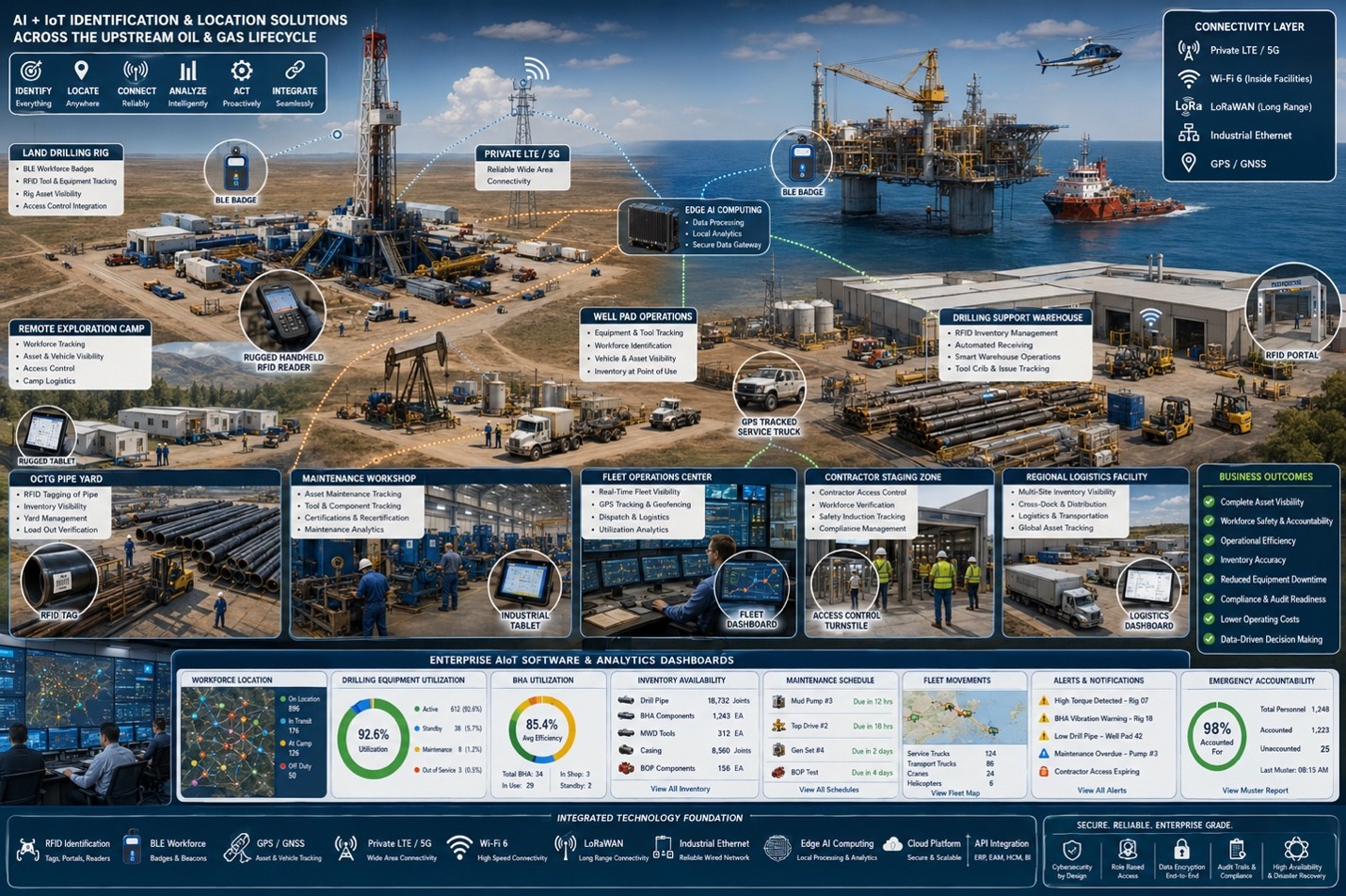
This enterprise illustration provides an executive-level overview of AIoT-enabled identification and location solutions across upstream oil and gas operations. It demonstrates how RFID, BLE, GPS, Private LTE, 5G, Wi-Fi 6, Industrial Ethernet, Edge AI, and enterprise software integrate to deliver real-time workforce visibility, drilling asset tracking, inventory management, fleet coordination, contractor access control, and operational analytics across drilling rigs, offshore platforms, warehouses, workshops, logistics facilities, and exploration sites.
Multi-Layered Field Identification & Analytics Engine
Why AI and IoT Is Transforming Upstream Exploration and Production
Modern exploration and production organizations manage thousands of operational activities simultaneously across drilling programs, offshore developments, exploration campaigns, production facilities, and regional logistics networks.
Every drilling project requires coordination among:
Each team depends on accurate information regarding workforce availability, equipment location, authorized site access, drilling inventory, maintenance resources, and operational readiness.
AI and IoT software enables exploration and production organizations to correlate these operational activities into a unified decision-support environment. AI evaluates identification and location events to recognize operational patterns, identify workflow bottlenecks, forecast resource requirements, and improve coordination across drilling campaigns.
Instead of reviewing isolated operational reports, drilling managers and field supervisors gain a continuously updated operational picture covering personnel deployment, drilling equipment utilization, inventory availability, contractor activities, and field logistics.
AI and IoT Technologies Supporting Upstream Operations
Petrovia AI incorporates enterprise-grade identification and wireless communication technologies commonly deployed throughout modern exploration and production operations. Supported technologies include:
These technologies operate together to create accurate identification and location information throughout upstream operations while supporting scalable enterprise software deployments.
Operational Benefits Across Exploration and Production
Exploration and production companies implement AI and IoT solutions to improve visibility across people, equipment, inventory, and operational activities that directly influence drilling efficiency and production continuity. Operational improvements commonly include:
These benefits contribute to lower operational delays, improved equipment utilization, stronger workforce accountability, and better decision-making throughout exploration and production activities.
Industry Experience Built on Real-World Oilfield Deployments
Petrovia AI combines decades of industrial IoT expertise with practical knowledge gained from complex enterprise deployments across industrial sectors. Developed within Aperture Venture Studio with support from GAO, the company draws upon more than twenty years of experience delivering thousands of IoT projects for organizations operating in demanding industrial environments.
Significant investments in research and development, rigorous quality assurance methodologies, and enterprise engineering practices have resulted in AI and IoT software capable of supporting large-scale upstream operations. Led by Ph.D. professionals and supported by multidisciplinary engineering teams, Petrovia AI has contributed to projects involving Fortune 500 companies, leading research institutions, major universities, and government agencies throughout the United States and Canada.
This experience enables Petrovia AI to deliver technically accurate, enterprise-grade software designed specifically for the operational realities of exploration, drilling, well completion, production support, and field logistics.
AIoT Workforce Location Analytics and Secure Access Management Workflow for Upstream Oil & Gas
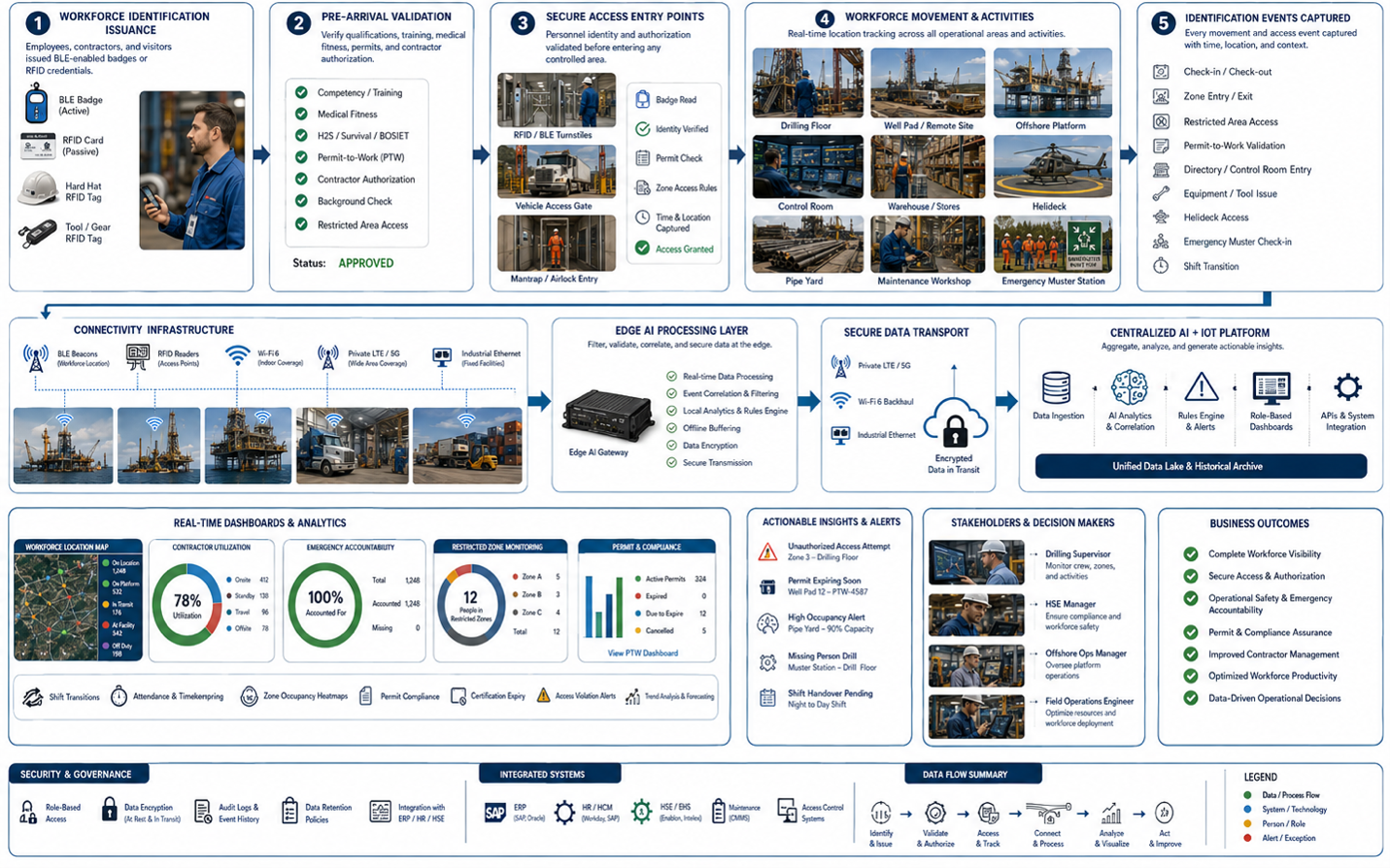
This workflow diagram illustrates how AIoT-enabled workforce identification and secure access management support upstream oil and gas operations. It demonstrates the complete process from BLE and RFID credential issuance, authorization, and site access through real-time workforce tracking, emergency accountability, secure data communications, Edge AI processing, and centralized analytics that provide workforce visibility, compliance reporting, permit management, and operational decision support across drilling, offshore, logistics, and maintenance facilities.
Workforce Location & Access Authorization Pipeline
Upstream Workforce Location Analytics
Exploration and production operations depend on highly coordinated field personnel working across drilling rigs, offshore systems, well pads, seismic survey areas, production facilities, pipe yards, maintenance workshops, logistics hubs, and temporary exploration camps. Maintaining accurate workforce visibility throughout these distributed environments is fundamental to operational continuity, personnel accountability, emergency preparedness, contractor coordination, and regulatory compliance.
Petrovia AI applies AI and IoT technologies to transform personnel identification and location events into operational analytics that support drilling managers, offshore supervisors, HSE teams, field operations leaders, logistics coordinators, and production engineers. Rather than relying on manual check-in procedures, radio communications, or paper-based workforce logs, the software continuously analyzes authorized personnel movement to provide operational awareness across exploration, drilling, well completion, intervention, and production support activities.
The solution combines BLE identification badges, RFID personnel credentials, GPS-enabled field mobility, Private LTE, 5G, Wi-Fi 6, Industrial Ethernet, rugged mobile computing, and Edge AI processing to provide reliable workforce location information across large upstream operating areas.
AI continuously evaluates workforce movement to identify operational trends such as:
These operational insights help organizations optimize workforce deployment while maintaining compliance with corporate HSE policies, permit-to-work procedures, and operational governance requirements.
Drilling Crew Location Analytics
Modern drilling operations involve multidisciplinary teams working simultaneously throughout the drilling lifecycle. Rotary drilling crews, directional specialists, MWD/LWD engineers, mud engineers, cementing contractors, wireline service providers, casing crews, and completion teams continuously move between operational work zones.
Offshore Personnel Tracking Analytics
Offshore production systems, drilling vessels, floating production units, and support facilities operate under strict workforce accountability requirements. Every employee, contractor, inspector, and technician must be accurately identified and authorized before accessing operational areas.
Oilfield Hazard Zone Worker Analytics
Upstream operations include numerous restricted operational environments where only authorized personnel with appropriate safety qualifications may perform work: drilling floors, BOP control areas, mud circulation systems, choke manifolds, and explosive storage facilities.
Emergency Evacuation Workforce Analytics
Emergency preparedness remains a critical requirement across upstream oil and gas. Well control incidents, severe weather, offshore alarms, production shutdowns, helicopter evacuations, and medical emergencies require immediate visibility into workforce accountability.
Wellsite Crew Movement Analytics
Large upstream developments frequently involve multiple simultaneous drilling programs distributed across several well pads and production areas. Coordinating drilling crews, logistics teams, maintenance personnel, and inspection groups requires continuous operational awareness.
Exploration and Production Site Access Management Analytics
Access management within upstream operations extends well beyond securing facility entrances. Exploration and production companies must verify that every employee, contractor, inspector, drilling specialist, maintenance technician, logistics provider, and visitor possesses the required training, certifications, work authorizations, and operational approvals before entering controlled work areas.
Petrovia AI combines enterprise identity management with AI and IoT software to evaluate every access event throughout exploration sites, drilling rigs, offshore systems, production facilities, maintenance workshops, logistics yards, pipe storage facilities, explosive magazines, warehouse operations, and regional support centers. Rather than functioning solely as an electronic access control solution, Petrovia AI converts access events into operational solution that improves workforce management, contractor utilization, operational compliance, and field security.
Drilling Site Entry Analytics
Active drilling locations experience continuous movement of personnel supporting exploration and production activities, including drilling crews, directional engineers, MWD/LWD specialists, mud loggers, wireline contractors, cementing service companies, and HSE officers.
Offshore System Access Compliance
Offshore installations require rigorous access governance because operational activities are conducted within controlled environments governed by international maritime safety regulations and strict corporate operating procedures.
Oilfield Contractor Authorization Analytics
Oilfield service providers play a central role throughout exploration and production. Drilling contractors, wireline companies, cementing specialists, and engineering consultants frequently support multiple drilling campaigns simultaneously.
Restricted Zone Access Analytics
Certain upstream operational environments require enhanced authorization: drilling floors, well control areas, BOP maintenance zones, choke manifolds, production process units, electrical switchgear rooms, chemical storage, and explosive magazines.
Safety Permit Verification Analytics
Permit-to-work procedures govern many upstream operational activities, including drilling maintenance, confined space entry, hot work, electrical servicing, heavy lifting operations, well intervention, and equipment servicing.
Oilfield Asset Tracking Analytics
Oil and gas upstream operations depend on continuous visibility into thousands of high-value assets distributed across exploration programs, land drilling rigs, offshore systems, well pads, drilling support bases, pipe yards, logistics hubs, maintenance workshops, regional warehouses, and production support facilities. Critical assets such as drill pipe, drill collars, heavyweight drill pipe, bottom hole assemblies (BHA), measurement while drilling (MWD) tools, logging while drilling (LWD) systems, rotary steerable systems (RSS), mud motors, stabilizers, reamers, casing, tubing, wellhead equipment, blowout preventer (BOP) components, pressure control equipment, generators, compressors, pumps, lifting equipment, and mobile service units are continuously deployed across multiple drilling campaigns.
Maintaining accurate visibility into these operational assets directly influences drilling efficiency, non-productive time (NPT), maintenance planning, equipment utilization, contractor coordination, and capital investment decisions. Petrovia AI applies AI and IoT technologies to transform equipment identification and location events into operational analytics that support exploration managers, drilling superintendents, maintenance planners, warehouse supervisors, logistics coordinators, and production operations teams. Rather than providing simple location tracking, Petrovia AI continuously analyzes asset movement, deployment frequency, utilization history, operational availability, maintenance records, and lifecycle events to improve enterprise-wide operational planning.
The solution combines RFID, BLE, GPS, rugged industrial identification tags, Private LTE, 5G, Wi-Fi 6, Industrial Ethernet, rugged handheld readers, mobile computing devices, and Edge AI processing to provide comprehensive asset visibility across upstream operations.
Drilling Equipment Location Analytics
Drilling programs rely on specialized equipment that frequently moves between drilling rigs, exploration campaigns, maintenance facilities, equipment staging areas, and regional warehouses. Delays in locating critical equipment can postpone rig mobilization and extend drilling schedules.
Downhole Tool Tracking Analytics
Downhole tools represent some of the most valuable operational assets in E&P. Rotary steerable systems (RSS), MWD/LWD tools, mud motors, drilling jars, fishing tools, stabilizers, and wireline equipment require continuous identification throughout their operational lifecycle.
Exploration Vehicle Tracking Analytics
Exploration and drilling activities depend on extensive vehicle fleets supporting operations across vast concessions. Fleets transport drilling personnel, maintenance crews, inspection teams, tubular goods, spare parts, fuel, and heavy equipment between sites.
Heavy Equipment Utilization Analytics
Large upstream projects deploy cranes, pipe handlers, forklifts, loaders, earthmoving equipment, lifting systems, generators, compressors, and hydraulic power units across multiple drilling locations.
E&P Asset Movement Prediction
Historical identification records provide valuable operational insights regarding equipment movement throughout exploration and production activities, enabling AI models to forecast future requirements.
Upstream Inventory Analytics
Inventory management throughout upstream operations extends far beyond conventional warehouse management. Exploration and production organizations must coordinate drilling consumables, OCTG materials, casing, tubing, drill pipe, drilling fluids, completion equipment, valves, fittings, wellhead components, pressure control equipment, maintenance parts, production consumables, safety equipment, and operational supplies across geographically dispersed drilling projects.
Petrovia AI transforms inventory identification events into operational analytics that improve visibility throughout drilling warehouses, offshore storage facilities, regional logistics centers, pipe yards, maintenance workshops, temporary field warehouses, and production support locations. By combining AI and IoT software with industrial identification technologies, organizations gain continuously updated visibility into inventory availability, movement history, material utilization, replenishment planning, and warehouse operations.
Drilling Material Inventory Visibility
Continuous drilling operations depend on reliable availability of drilling materials: drill pipe, drill collars, casing strings, production tubing, wellheads, valves, cementing supplies, drilling chemicals, completion hardware, and pressure control consumables.
E&P Spare Parts Optimization
Maintenance organizations require immediate access to critical spare parts supporting drilling equipment, production facilities, power generation units, lifting systems, rotating machinery, and field service operations.
Wellsite Supply Inventory Analytics
Remote drilling operations frequently operate with independently managed inventories due to limited transportation access and long replenishment lead times from central supply bases.
Oilfield Warehouse Stock Management
Regional drilling warehouses serve as critical logistics centers supporting exploration programs, drilling campaigns, production facilities, maintenance operations, and contractor activities.
Critical Equipment Availability Analytics
Certain equipment categories must remain continuously available because operational interruptions can significantly affect drilling schedules: BOP components, wellhead equipment, pressure control manifolds, MWD/LWD tools, and RSS assemblies.
AI and IoT Integration for Oil & Gas Upstream Operations
Enterprise AI and IoT deployments generate the greatest operational value when identification and location information is integrated with the business systems already supporting exploration, drilling, well construction, production support, maintenance, procurement, logistics, workforce management, and regulatory compliance. Exploration and production organizations rarely operate a single software environment. Instead, they depend on interconnected enterprise applications that manage drilling programs, field operations, equipment maintenance, warehouse logistics, contractor administration, financial management, and engineering documentation.
Petrovia AI is designed to integrate with these enterprise environments, enriching operational records with AI-generated insights derived from workforce identification, equipment location, inventory movement, access authorization, and asset lifecycle events. Rather than replacing existing enterprise software, Petrovia AI extends operational visibility by providing a unified view of people, equipment, inventory, and field activities throughout upstream operations.
The software supports secure bidirectional data exchange using enterprise APIs, industrial messaging services, database synchronization, event-driven integration, and standards-based communication methods that align with enterprise IT governance.
Enterprise Software Integration
Petrovia AI integrates operational identification and location information with core business platforms to improve workflow coordination and enterprise-wide decision support across exploration and production organizations.
Edge AI Deployment for Remote Exploration and Drilling
Many upstream operations are conducted in remote deserts, offshore facilities, mountain regions, arctic environments, and isolated basins where connectivity may be intermittent or bandwidth-constrained. Local processing ensures zero-downtime analytics.
Cloud Deployment for Multi-Site Operations
Large exploration and production organizations manage drilling campaigns across multiple basins, offshore developments, regional operating companies, and international assets. Cloud deployment enables centralized management with real-time operational visibility.
Private Server Deployment
Some E&P organizations operate under strict cybersecurity policies, national regulations, or data sovereignty mandates requiring software deployment within enterprise-controlled infrastructure and on-premises data centers.
Industrial Wireless Technologies Supporting Upstream Operations
Reliable identification and location services require industrial communication technologies capable of supporting challenging oilfield conditions, ATEX/IECEx hazardous zones, and long-range remote telemetry.
Operational Benefits for Exploration and Production Organizations
Implementing AI and IoT identification and location solutions enables measurable operational improvements across exploration, drilling, well construction, production support, maintenance, logistics, and warehouse operations. Organizations commonly achieve:
These improvements help exploration and production companies reduce operational delays, improve capital utilization, strengthen governance, and maintain safer field operations throughout the drilling lifecycle.
Why Petrovia AI
Petrovia AI develops enterprise AI and IoT software specifically for oil and gas upstream operations within the Energy & Utilities Industry. Every software capability is engineered around the operational realities of exploration programs, drilling campaigns, offshore production, wellsite logistics, contractor management, equipment maintenance, warehouse operations, and production support rather than generalized industrial workflows.
The software incorporates terminology, operational practices, and engineering workflows familiar to exploration companies, drilling contractors, offshore operators, oilfield service providers, engineering organizations, and integrated energy companies. This industry-focused approach enables organizations to deploy AI and IoT solutions that align naturally with existing drilling and production operations.
Petrovia AI was established within Aperture Venture Studio with support from GAO and is built upon more than two decades of industrial IoT experience gained through thousands of successful customer deployments. Continuous investment in research and development, enterprise software engineering, quality assurance, and technical support has produced scalable solutions capable of supporting complex upstream operations.
The organization is led by Ph.D. professionals and supported by experienced engineers with backgrounds spanning industrial automation, enterprise software, AI, IoT, industrial communications, and energy operations. Over the years, the broader engineering organization has supported Fortune 500 corporations, leading research institutions, major universities, and government agencies across the United States and Canada, providing practical experience that contributes directly to Petrovia AI's enterprise software capabilities.