AI and IoT Applications Delivering Operational Visibility Across Exploration, Drilling, Well Construction, and Upstream Field Operations
Enterprise AIoT Applications Connecting Drilling Workforce Tracking, Offshore Logistics, Downhole Tool Identification, OCTG Inventory, and Remote Wellsite Operations
Explore Upstream ApplicationsAI and IoT Supports Every Phase of Upstream Exploration and Production
Modern upstream organizations simultaneously manage exploration programs, appraisal drilling, production drilling, sidetrack operations, workover activities, completion campaigns, well intervention projects, maintenance shutdowns, contractor mobilizations, and logistics operations across multiple geographic regions.
Each activity introduces operational complexity through continuous movement of people, drilling assets, service equipment, completion tools, tubular goods, rental equipment, maintenance inventories, and transportation resources.
AI and IoT software becomes particularly valuable where operational decisions depend upon knowing:
These operational questions directly affect drilling productivity, HSE performance, maintenance planning, procurement efficiency, and project scheduling.
By continuously collecting verified identification events from industrial RFID systems, BLE personnel credentials, GPS-enabled mobile assets, rugged handheld readers, fixed identification gateways, cellular communication systems, and Edge AI software, upstream organizations establish a highly accurate operational record that supports enterprise decision-making without introducing unnecessary administrative burden.
Operational Environments Where AIoT Creates Business Value
Petrovia AI solutions are designed for the broad operational landscape encountered throughout upstream exploration and production activities. Because operational workflows vary between conventional fields, unconventional shale plays, offshore developments, enhanced recovery projects, and frontier exploration programs, software flexibility remains essential.
Typical operational deployment environments include:
AI + IoT Powering the Upstream Oil & Gas Value Chain: Enterprise Workforce, Asset & Inventory Visibility
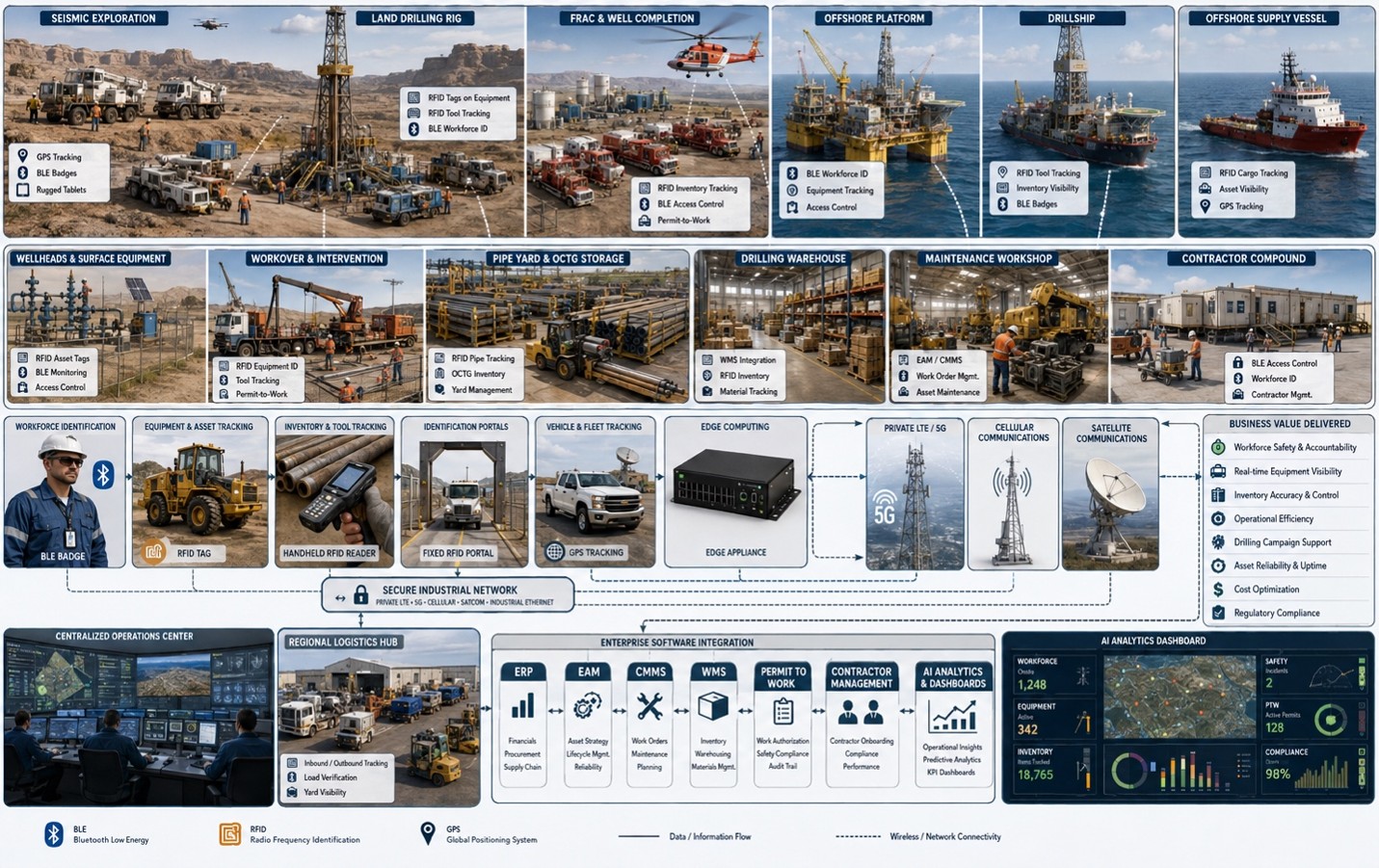
This enterprise illustration demonstrates how AI, RFID, BLE, GPS, edge computing, and secure industrial communications enable end-to-end workforce identification, equipment tracking, inventory visibility, and logistics coordination across upstream oil and gas operations. It also highlights enterprise software integration with ERP, EAM, CMMS, WMS, permit-to-work, contractor management, and AI analytics platforms to improve operational efficiency, safety, and asset utilization.
Why Identification and Location Visibility Matter in Upstream Operations
Every upstream drilling campaign depends on accurate knowledge of who is onsite, what equipment is available, where critical assets are located, and when operational resources are ready for deployment. Delays in locating drilling assemblies, verifying contractor access, allocating tubular inventories, or mobilizing specialized completion equipment can affect drilling schedules, increase nonproductive time (NPT), and reduce operational efficiency.
Identification-driven AI and IoT solutions address these challenges by creating a continuously updated operational record based on verified workforce identities and asset movements rather than manual spreadsheets or isolated databases. RFID establishes persistent identification for drilling equipment, OCTG, and high-value assets. BLE supports workforce identification and authorized location awareness. GPS improves fleet and mobile equipment coordination across expansive oilfields. Private LTE and 5G provide resilient communications for distributed field operations, while Edge AI processes operational events locally before synchronizing with enterprise software.
The result is a more connected upstream operation where drilling supervisors, HSE managers, logistics coordinators, maintenance planners, warehouse personnel, procurement teams, and executive leadership can make informed decisions using trusted operational data.
Drilling Workforce Safety Management
Upstream oil and gas operations rely on highly coordinated teams working across drilling rigs, offshore systems, remote exploration camps, well completion sites, workover operations, hydraulic fracturing support facilities, drilling warehouses, pipe yards, helicopter staging areas, marine logistics terminals, and contractor compounds. Personnel frequently transition between active wellsites, maintenance workshops, restricted operational zones, temporary accommodation facilities, and transportation hubs throughout each shift.
Traditional attendance logs, manual check-in procedures, paper-based permit records, and spreadsheet-based personnel registers often cannot keep pace with rapidly changing operational conditions. Petrovia AI combines industrial identification technologies, Edge AI, machine learning, and enterprise software integration to provide continuous workforce identification and operational visibility.
Drilling Crew Location Analytics
Associates verified personnel identities with active drilling floors, mud systems, pipe handling zones, BOP maintenance areas, cementing, and wireline work zones to optimize crew distribution and shift transitions.
Offshore Personnel Tracking Analytics
Maintains verified personnel accounting across helidecks, accommodation modules, derrick decks, pipe handling areas, utility modules, and muster stations on drillships and offshore platforms.
Oilfield Hazard Zone Workforce Analytics
Automatically verifies that only qualified and authorized personnel enter BOP testing areas, high-pressure pumping zones, confined spaces, crane lifting perimeters, and hot work areas.
Emergency Evacuation Workforce Analytics
Provides zero-latency workforce accountability during well control incidents, fire alarms, toxic gas releases, severe weather, and offshore helicopter evacuations.
AIoT Workforce Lifecycle Management Workflow for Upstream Oil & Gas Emergency Accountability
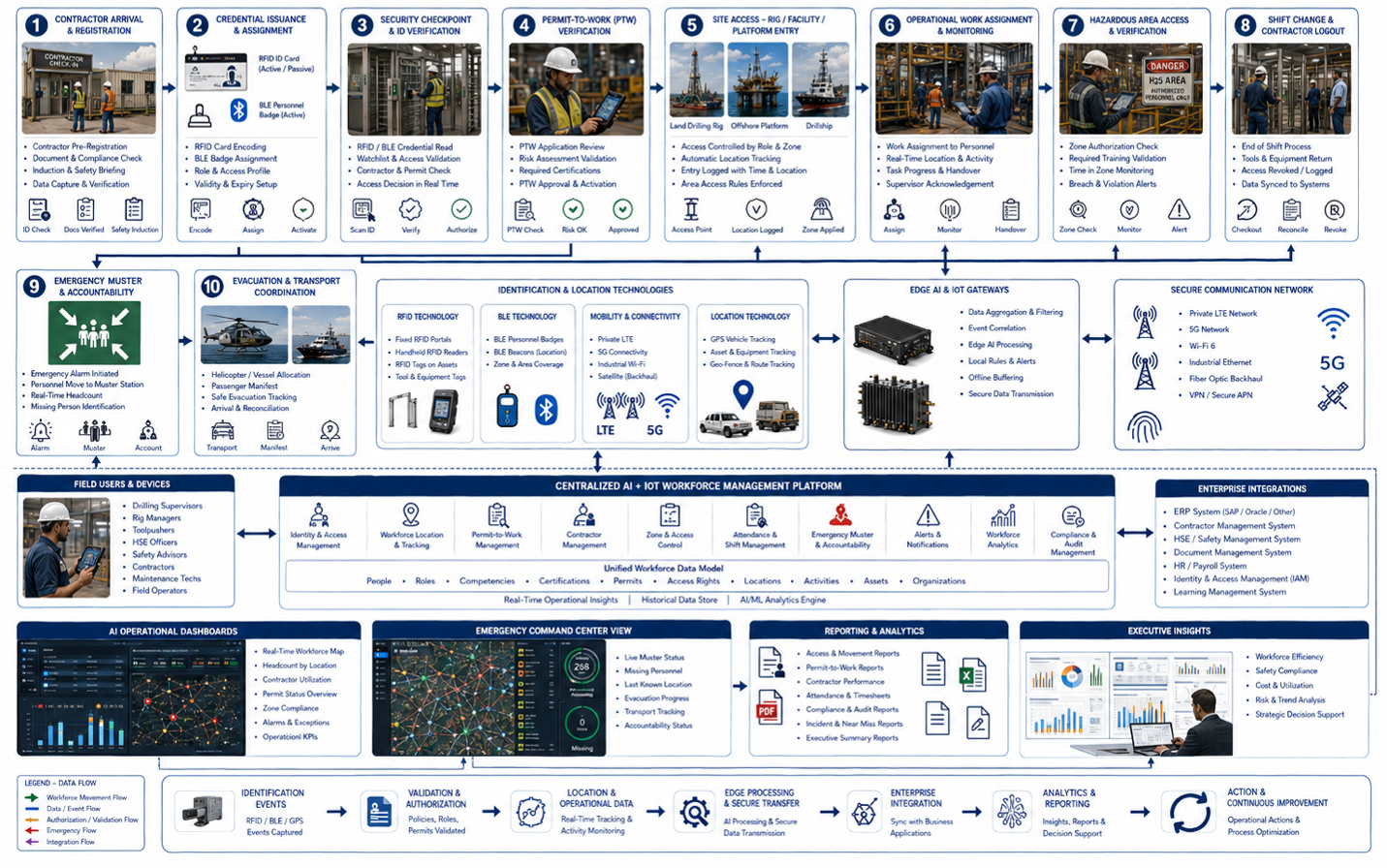
This enterprise workflow diagram illustrates the complete AIoT-enabled workforce lifecycle across upstream oil and gas operations, from contractor registration and credential issuance to secure site access, permit-to-work verification, operational assignments, hazardous area authorization, emergency mustering, evacuation coordination, and enterprise reporting. It demonstrates how RFID, BLE, Edge AI, Private LTE, 5G, rugged mobile devices, and integrated enterprise software deliver real-time workforce visibility, access governance, compliance management, emergency accountability, and operational analytics across drilling, offshore, logistics, and maintenance environments.
Offshore Personnel Tracking Across Exploration, Drilling, and Production Facilities
Offshore exploration and production assets present some of the most demanding workforce management requirements within the Energy & Utilities Industry. Personnel are routinely transported by helicopter and crew transfer vessels, often working rotational schedules across drilling campaigns, production operations, maintenance shutdowns, inspection programs, and well intervention projects. Every movement must be accurately documented to support operational continuity, regulatory compliance, and workforce accountability.
Petrovia AI enables operators to establish a unified workforce identification solution spanning offshore systems, floating production facilities, drillships, jack-up rigs, semi-submersible drilling units, offshore logistics bases, marine support vessels, and onshore operational centers. AI and IoT software correlates verified personnel identities with authorized operational locations, creating a trusted operational record that supports drilling supervisors, offshore installation managers, HSE teams, logistics coordinators, and executive leadership.
Beyond day-to-day workforce coordination, the same identification data improves long-term operational planning by revealing workforce utilization trends, contractor deployment patterns, offshore accommodation occupancy, maintenance staffing requirements, and project resource allocation. When integrated with ERP, EAM, CMMS, and contractor management software, these insights contribute to more efficient offshore operations while strengthening safety, compliance, and operational resilience across complex upstream exploration and production environments.
Oilfield Equipment Visibility & Analytics
Exploration and production organizations depend on continuous visibility of thousands of mobile and fixed assets that support drilling, well construction, completion, workover, intervention, production support, and field logistics. These assets routinely move between drilling rigs, offshore systems, pipe yards, maintenance workshops, inspection facilities, contractor compounds, regional warehouses, offshore supply vessels, helicopter staging areas, and remote exploration sites.
Drilling Equipment Location Analytics
Continuous location visibility and utilization tracking for top drives, drawworks, rotary tables, mud pumps, BOP stacks, choke manifolds, drill pipe, HWDP, drill collars, and Kelly systems.
Downhole Tool Identification & Lifecycle Management
Establishes persistent operational histories for Rotary Steerable Systems (RSS), mud motors, MWD/LWD tools, drill bits, reamers, stabilizers, fishing tools, and wireline assemblies.
Exploration Vehicle Tracking Analytics
Provides GPS telematics and operational coordination for geological survey trucks, drilling support fleets, water tankers, fuel delivery trucks, pipe haulers, and field service vehicles.
Heavy Equipment Utilization & AI Movement Prediction
Tracks mobile cranes, telehandlers, excavators, and generators while AI models forecast future equipment demand, rig mobilization requirements, and seasonal logistics bottlenecks.
Remote Exploration Asset & Drilling Material Management
Exploration activities frequently extend across remote basins, unconventional shale plays, offshore lease blocks, frontier exploration areas, and geographically dispersed drilling programs where operational assets remain deployed for extended periods.
Remote Exploration Asset Management
Establishes a unified operational view across seismic acquisition equipment, survey instruments, core sample containers, mobile laboratories, temporary offices, communications trailers, and remote power systems.
Drilling Material Management
Continuous identification and movement tracking for OCTG tubulars, casing strings, production tubing, wellhead assemblies, Christmas trees, cementing hardware, valves, flanges, and lifting gear.
E&P Inventory Optimization
Synchronizes real-time identification events with enterprise ERP, WMS, and CMMS platforms across central warehouses, regional supply bases, offshore hubs, and rig storage.
Why Petrovia AI for Oil & Gas Upstream AI and IoT Applications
Petrovia AI develops enterprise AI and IoT software specifically for upstream exploration and production organizations operating complex drilling, offshore, well construction, and field logistics environments. Every solution is engineered around industrial identification, asset location visibility, workforce accountability, inventory optimization, and operational traceability rather than generalized monitoring technologies.
Typical enterprise software integrations include:
Experience, Engineering Expertise, and Industry Credibility
Petrovia AI was established within Aperture Venture Studio, with strategic support from GAO, building upon more than two decades of industrial IoT implementation experience across complex industrial environments.
This experience includes supporting thousands of IoT customers and successfully delivering thousands of industrial projects involving workforce identification, enterprise asset tracking, inventory visibility, industrial software integration, and operational traceability. The practical knowledge gained from these deployments directly informs the design and implementation of Petrovia AI solutions for upstream oil and gas operations.
The organization is led by Ph.D. professionals from internationally recognized universities and is supported by highly experienced technical specialists. Over the years, the broader engineering organization has contributed to projects supporting Fortune 500 corporations, leading engineering companies, research laboratories, prestigious universities, and government agencies across the United States and Canada.
Building Intelligent Upstream Operations with AI, IoT, and Industrial Connectivity
Oil and gas upstream operations continue to increase in operational complexity as exploration programs expand into more remote environments, drilling campaigns become more data-driven, and organizations manage larger fleets of personnel, contractors, drilling assets, tubular inventories, and mobile equipment across distributed field operations.
Enterprise AI and IoT solutions provide the identification, location visibility, and operational transparency required to coordinate these complex activities efficiently. By combining RFID, BLE, GPS, Private LTE, 5G, Edge AI, machine learning, rugged industrial identification hardware, and enterprise software integration, upstream organizations can improve workforce accountability, optimize equipment utilization, strengthen inventory management, enhance drilling logistics, and maintain comprehensive asset lifecycle documentation.