Resources for Oil & Gas Upstream AIoT Solutions for Exploration, Drilling, and Production Operations
Comprehensive Technical Guidance, Implementation Frameworks, Deployment Methodologies, and Integration References for Enterprise Oilfield AI and IoT
Access AIoT Resource LibraryAI and IoT Resource Center for Oil & Gas Upstream Operations
Digital transformation within upstream oil and gas operations requires considerably more than installing connected devices or deploying enterprise software. Successful implementation depends on understanding operational workflows, equipment mobility, workforce movement, hazardous-area requirements, communication infrastructure, enterprise integration, and long-term operational governance.
Oil and gas upstream environments present unique operational challenges. Exploration campaigns often span remote geographic regions, drilling assets move between wellsites, offshore facilities operate continuously under demanding environmental conditions, and thousands of workers, contractors, vehicles, drilling tools, tubulars, completion equipment, and critical spare parts must remain accurately identified throughout their operational lifecycle.
AI and IoT combines AI with industrial IoT devices, connected identification technologies, Edge AI, machine learning, computer vision where applicable, and enterprise software to improve operational visibility and support better decision-making. Within upstream operations, the greatest operational value frequently comes from accurate identification and location awareness rather than environmental sensing. Reliable identification of personnel, mobile equipment, drilling assets, inventory, and operational workflows improves safety, productivity, regulatory compliance, and asset utilization while reducing unnecessary manual administration.
The Petrovia AI Resource Center has been developed specifically for engineers, operations managers, drilling supervisors, exploration specialists, maintenance professionals, HSE teams, enterprise architects, warehouse managers, and IT leaders responsible for planning or expanding AI and IoT initiatives across upstream operations.
Rather than providing promotional content, these resources deliver practical engineering guidance, implementation methodologies, deployment recommendations, integration practices, and technical references derived from real industrial projects and operational experience.
Who Should Use These Technical Resources
The information within this knowledge center supports multidisciplinary teams responsible for designing, deploying, operating, maintaining, and continuously improving AI and IoT solutions across exploration and production environments.
Typical users and stakeholders include:
Because upstream operations involve multiple stakeholders, the resources are written using technically accurate terminology that enables engineering, operational, and business teams to establish common implementation standards throughout the organization.
Resources for Oil & Gas Upstream AIoT: Enterprise Identification, Asset Visibility & Operational Coordination
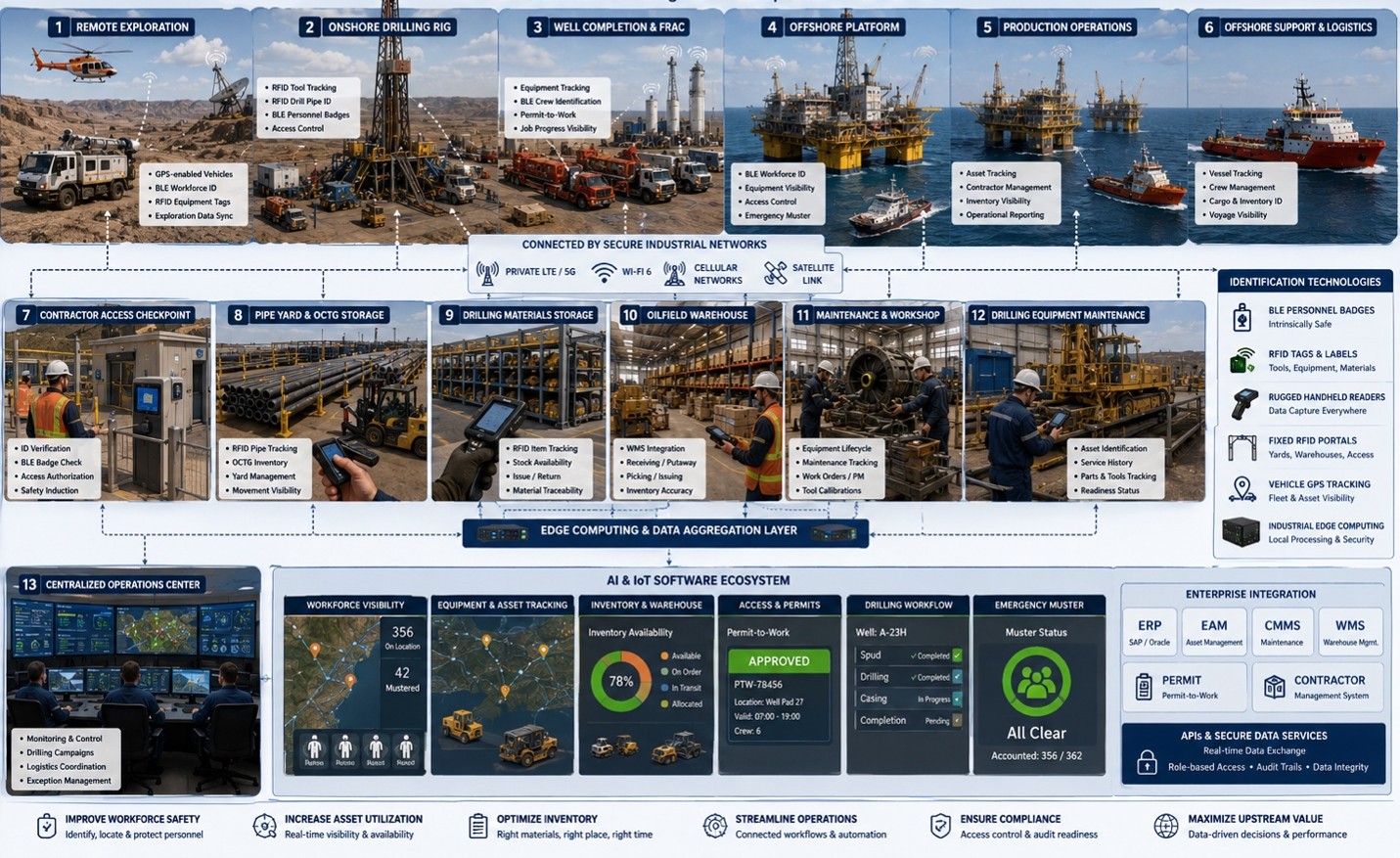
This enterprise illustration provides an executive overview of AIoT-enabled upstream oil and gas operations, connecting exploration, drilling, offshore production, warehousing, maintenance, logistics, and centralized operations through RFID, BLE, GPS, edge computing, and secure industrial networks. It demonstrates how enterprise software delivers real-time workforce visibility, equipment tracking, inventory management, access control, emergency readiness, and operational coordination across the upstream value chain.
Purpose of the Oilfield AI and IoT Knowledge Library
Every AI and IoT deployment begins with technical understanding rather than hardware selection. Organizations must evaluate operational objectives, workforce workflows, communication technologies, enterprise software compatibility, hazardous-area requirements, cybersecurity policies, and future expansion plans before implementation begins.
This resource library is intended to help organizations understand:
Workforce Location & Personnel Accountability
BLE identification combined with AI software provides personnel visibility, supports emergency mustering, manages hazard-area occupancy, coordinates evacuations, and validates contractor presence.
Oilfield Access Management
Provides digital identity verification to control entry into drilling rigs, offshore systems, BOP maintenance compounds, workshops, and restricted hazard zones.
Oilfield Equipment Identification & Location
RFID and GPS provide continuous asset visibility for BOPs, top drives, mud pumps, drill pipe, tubulars, wireline units, completion tools, and mobile workshops.
Inventory Visibility & Lifecycle Traceability
Maintains verified material availability across warehouses and pipe yards while establishing persistent inspection and certification histories for safety-critical tools.
What You Will Find Within the Resource Center
The Petrovia AI knowledge library organizes technical information into practical engineering categories that support organizations throughout every stage of AI and IoT adoption.
Available resource categories include:
Practical Knowledge Built on Proven Industrial Experience
The technical guidance throughout this resource center reflects practical industrial experience gained through real-world AI and IoT deployments rather than theoretical implementation models. Petrovia AI was established within Aperture Venture Studio with support from GAO and builds upon more than two decades of IoT expertise across thousands of enterprise projects.
Extensive investment in research and development, rigorous quality assurance processes, and highly experienced engineering teams contribute to the accuracy and reliability of every technical document published. Led by Ph.D. professionals from leading universities and supported by strategic industry experts, Petrovia AI has contributed to projects involving Fortune 500 manufacturers, internationally recognized research organizations, prestigious universities, and government agencies throughout the United States and Canada.
AIoT Identification and Location Solutions Deployment Lifecycle for Upstream Oil & Gas Operations
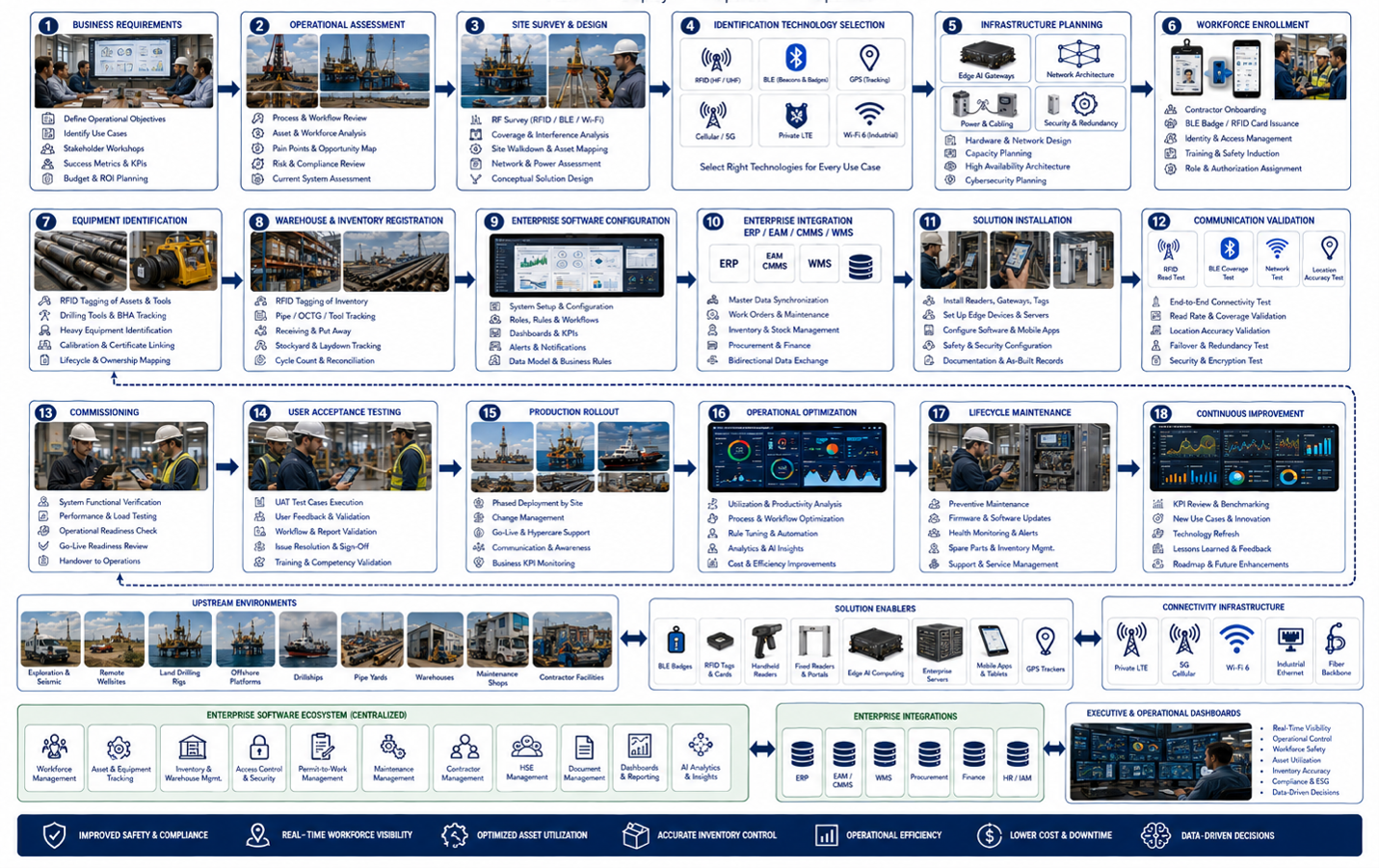
This enterprise workflow diagram illustrates the complete deployment lifecycle for AIoT identification and location solutions across upstream oil and gas operations. It follows the implementation process from business requirements and operational assessment through technology selection, infrastructure planning, workforce enrollment, equipment identification, enterprise software integration, installation, commissioning, production rollout, lifecycle maintenance, and continuous improvement, demonstrating how RFID, BLE, GPS, Private LTE, Wi-Fi 6, Edge AI, and enterprise software enable secure workforce visibility, asset tracking, inventory management, and operational intelligence.
Oilfield AI and IoT Documentation Library
Comprehensive technical documentation is one of the most important success factors for AI and IoT deployments across oil and gas upstream operations. Well-structured documentation establishes consistent implementation practices, reduces deployment risk, improves maintainability, supports regulatory compliance, and enables enterprise-wide standardization across geographically distributed exploration and production (E&P) assets.
Workforce Location Documentation
Details BLE badge enrollment, contractor onboarding, shift assignments, hazardous-area authorizations, emergency muster procedures, and evacuation planning for drilling rigs and offshore platforms.
Oilfield Access Control Documentation
Provides implementation standards for site entry authorization, drilling rig security, offshore credentialing, permit-to-work validation, and restricted area policy enforcement.
Asset Identification & Inventory Documentation
Explains durable RFID attachment methods, environmental tolerance specs, and standardized workflows for warehouse receiving, OCTG pipe yard storage, and AI-driven replenishment.
E&P Deployment Guides
AI and IoT deployments within exploration and production operations require structured implementation methodologies because upstream operating environments differ substantially from conventional industrial facilities. The Petrovia AI deployment guide library provides engineering-based methodologies that help organizations implement identification and location solutions while maintaining operational continuity.
Operational Assessment & Site Readiness
Evaluates exploration workflows, drilling schedules, completions, workforce logistics, existing IT/OT systems, communication coverage, and hazardous-area classifications to create a deployment roadmap.
Identification Tech Selection & Infrastructure Planning
Provides comparative analysis of RFID, BLE, GPS, Cellular, Private LTE, and Wi-Fi 6 while outlining site survey methods, mounting standards, and power infrastructure.
Enterprise Software Integration & Validation
Details REST API connectivity, data sync, and security controls for ERP, EAM, CMMS, and WMS platforms, followed by structured commissioning and user acceptance testing.
Oilfield Asset Tracking Resources
Maintaining accurate equipment identification throughout asset movements improves operational efficiency, reduces nonproductive time (NPT), strengthens maintenance planning, and supports regulatory compliance across drilling, exploration, and production.
Drilling Equipment & Downhole Tool Traceability
Implementation guidance for RFID lifecycle tracking of land rigs, offshore packages, BOPs, top drives, RSS tools, mud motors, MWD/LWD assemblies, casing, and tubulars.
Exploration Vehicles & Oilfield Warehouse Resources
GPS fleet telematics for survey trucks, water tankers, and pipe haulers, integrated with RFID warehouse management for receiving, picking, staging, and dispatch.
Oilfield Technical Specifications
Selecting appropriate identification technologies requires careful evaluation of operational objectives, environmental conditions, communication infrastructure, hazardous-area classifications, and software compatibility.
RFID & BLE Hardware Specifications
Engineering parameters for UHF/HF passive tags, metal-mount tags, high-temp tags, fixed portals, handheld readers, industrial BLE badges, and ATEX/IECEx intrinsically safe credentials.
Communications & Enterprise Integration Specifications
Architecture standards for GPS telematics, Private LTE, industrial Wi-Fi 6, secure REST APIs, role-based access control, encryption, and operational audit logging.
Engineering Standards and Deployment Best Practices
Long-term AI and IoT success depends upon engineering discipline, standardized operational procedures, and consistent lifecycle management. Documented governance practices ensure identification methods remain accurate, scalable, secure, and repeatable across multiple operating regions.
The engineering best-practice library includes guidance for:
Oil & Gas Upstream AIoT Frequently Asked Questions
Q1 Which upstream operations benefit most from AI and IoT identification and location solutions?
AI and IoT delivers measurable operational improvements throughout exploration, drilling, well construction, well completion, production support, field logistics, maintenance operations, warehouse management, contractor administration, and equipment lifecycle management.
Organizations often prioritize deployments where they need to improve workforce accountability, restricted-area access authorization, drilling equipment visibility, downhole tool traceability, OCTG identification, warehouse inventory accuracy, mobile equipment utilization, contractor management, operational documentation, and enterprise reporting. Projects typically begin with high-value operational assets before expanding into enterprise-wide workforce location, inventory visibility, and lifecycle traceability.
Q2 Which wireless technologies are commonly deployed in upstream AI and IoT solutions?
Technology selection depends on operational requirements, communication availability, hazardous-area classifications, infrastructure maturity, and mobility requirements.
Common technologies include RFID for drilling equipment identification, warehouse inventory, OCTG management, and material traceability; BLE for workforce identification, contractor credentials, personnel accountability, and emergency mustering; GPS for exploration fleets, heavy equipment, mobile workshops, and remote field assets; Private LTE for secure communication across extensive drilling and production facilities; Cellular for remote wellsites; and Wi-Fi 6 for warehouses, maintenance facilities, and offices. Many deployments combine multiple technologies into hybrid networks.
Q3 How does AI and IoT improve drilling equipment utilization?
Equipment utilization improves when engineering and operations teams can accurately identify asset location, availability, maintenance status, deployment history, and operational assignments. Identification-based visibility reduces time spent locating equipment, minimizes duplicate purchases, improves equipment scheduling, supports maintenance planning, and enables faster mobilization between drilling campaigns. Historical utilization records also assist capital planning and lifecycle replacement decisions.
Q4 Can AI and IoT integrate with existing upstream enterprise software?
Yes. Enterprise AI and IoT software is typically integrated with existing operational and business applications to eliminate duplicate information management and improve operational consistency. Common integrations include ERP (SAP, Oracle), EAM / CMMS (IBM Maximo), WMS, GIS, IAM, drilling operations software (WITSML), maintenance planning applications, contractor management systems, business reporting software, and executive dashboards.
Q5 How do AI and IoT identification solutions support workforce safety?
AI and IoT supports workforce safety by improving personnel accountability rather than replacing existing HSE procedures. BLE identification badges and authenticated access management enable organizations to verify worker presence, manage hazardous-area entry, support emergency mustering, coordinate evacuation activities, validate contractor authorization, and maintain historical attendance records. During drilling campaigns and offshore operations, these capabilities provide supervisors with improved workforce visibility while supporting established emergency response procedures.
Q6 Are AI and IoT solutions suitable for both offshore and onshore operations?
Yes. Enterprise AI and IoT identification solutions are designed to support a broad range of upstream environments, including land drilling rigs, offshore drilling systems, fixed production systems, remote exploration camps, well completion sites, pipe yards, maintenance workshops, regional warehouses, logistics centers, and temporary contractor compounds. Deployment methodologies are adapted according to environmental conditions, communication infrastructure, hazardous-area classifications, workforce size, and operational workflows.
Q7 What should organizations evaluate before beginning an AI and IoT deployment?
Successful projects typically begin with a structured engineering assessment that evaluates business objectives, operational workflows, workforce movement, equipment mobility, inventory processes, existing enterprise software, communication infrastructure, hazardous-area requirements, cybersecurity policies, regulatory obligations, and future digital transformation initiatives. A comprehensive assessment establishes realistic implementation priorities while reducing deployment risk and simplifying future expansion.
Continuous Learning for Upstream Digital Transformation
AI and IoT deployment is an ongoing engineering journey rather than a one-time implementation project. As exploration programs expand, drilling technologies evolve, and enterprise operational requirements become more sophisticated, organizations benefit from continuously updated technical knowledge that reflects current industry practices.
Future technical resources will continue addressing emerging topics including:
Engineering Expertise Built Through Industrial Experience
The technical guidance provided throughout the Petrovia AI Resource Center reflects practical implementation knowledge developed through extensive enterprise AI and IoT experience. Petrovia AI was established within Aperture Venture Studio with support from GAO and builds upon more than two decades of industrial IoT expertise gained through thousands of successful enterprise projects across complex industrial environments.
Continuous investment in research and development, rigorous quality assurance processes, and experienced engineering teams ensures that technical documentation remains accurate, practical, and aligned with current enterprise deployment practices. The organization is led by Ph.D. professionals from leading universities and supported by recognized industry experts, strategic technology partners, and experienced solution architects.
Over the years, this expertise has contributed to projects supporting Fortune 500 organizations, internationally recognized research institutions, prestigious universities, and government agencies throughout the United States and Canada. These real-world implementation experiences shape every deployment guide, engineering reference, technical specification, and operational best practice published within the Petrovia AI knowledge library.