AI and IoT Hardware Technologies for Oil & Gas Upstream Operations
Rugged RFID, BLE, GPS, Private LTE, 5G, Wi-Fi 6, and Edge AI Hardware Engineered for Upstream Exploration, Drilling, and Production Asset Visibility
Consult Hardware TeamIoT Hardware Technologies for AIoT-Enabled Oil & Gas Upstream Operations
Exploration and production organizations operate within some of the world's most technically demanding industrial environments. Land drilling rigs, offshore systems, drillships, jack-up rigs, semi-submersibles, well pads, completion sites, hydraulic fracturing support bases, directional drilling operations, pipe yards, helicopter terminals, marine supply ports, regional maintenance centers, and remote exploration camps require industrial hardware capable of maintaining dependable identification and location performance despite vibration, abrasive drilling fluids, corrosive offshore conditions, extreme temperatures, heavy mechanical impacts, and continuous equipment relocation.
Modern upstream operations involve thousands of mobile assets moving across geographically dispersed oilfields. Drill pipe, casing strings, tubing, Bottom Hole Assemblies (BHA), Measurement While Drilling (MWD) systems, Logging While Drilling (LWD) tools, Rotary Steerable Systems (RSS), mud motors, fishing tools, blowout preventers (BOP), choke manifolds, wellhead assemblies, pressure control equipment, cementing units, coiled tubing equipment, wireline units, cranes, forklifts, mobile workshops, rental equipment, contractor assets, and critical spare parts frequently transition between warehouses, offshore supply vessels, drilling locations, refurbishment facilities, and maintenance depots.
Maintaining continuous operational visibility across these assets requires industrial AI and IoT hardware designed specifically for upstream exploration and production. Petrovia AI delivers rugged identification and location technologies that establish persistent digital identities for personnel, equipment, inventory, vehicles, and operational materials throughout every phase of the upstream asset lifecycle.
Rather than emphasizing conventional monitoring applications, our hardware solutions prioritize enterprise identification, asset location visibility, workforce accountability, inventory transparency, and lifecycle documentation. Every identification event becomes structured operational data that supports engineering analysis, logistics coordination, maintenance planning, contractor administration, and regulatory reporting.
Petrovia AI hardware solutions integrate with existing enterprise operational software, including:
Supported industrial wireless and networking technologies include:
When integrated with AI and IoT software, these technologies convert identification and location events into operational insights that improve drilling logistics, equipment utilization, warehouse efficiency, contractor accountability, workforce coordination, inventory optimization, and upstream regulatory compliance.
Typical deployment environments include:
AI + IoT Hardware Ecosystem for Upstream Oil & Gas Operations
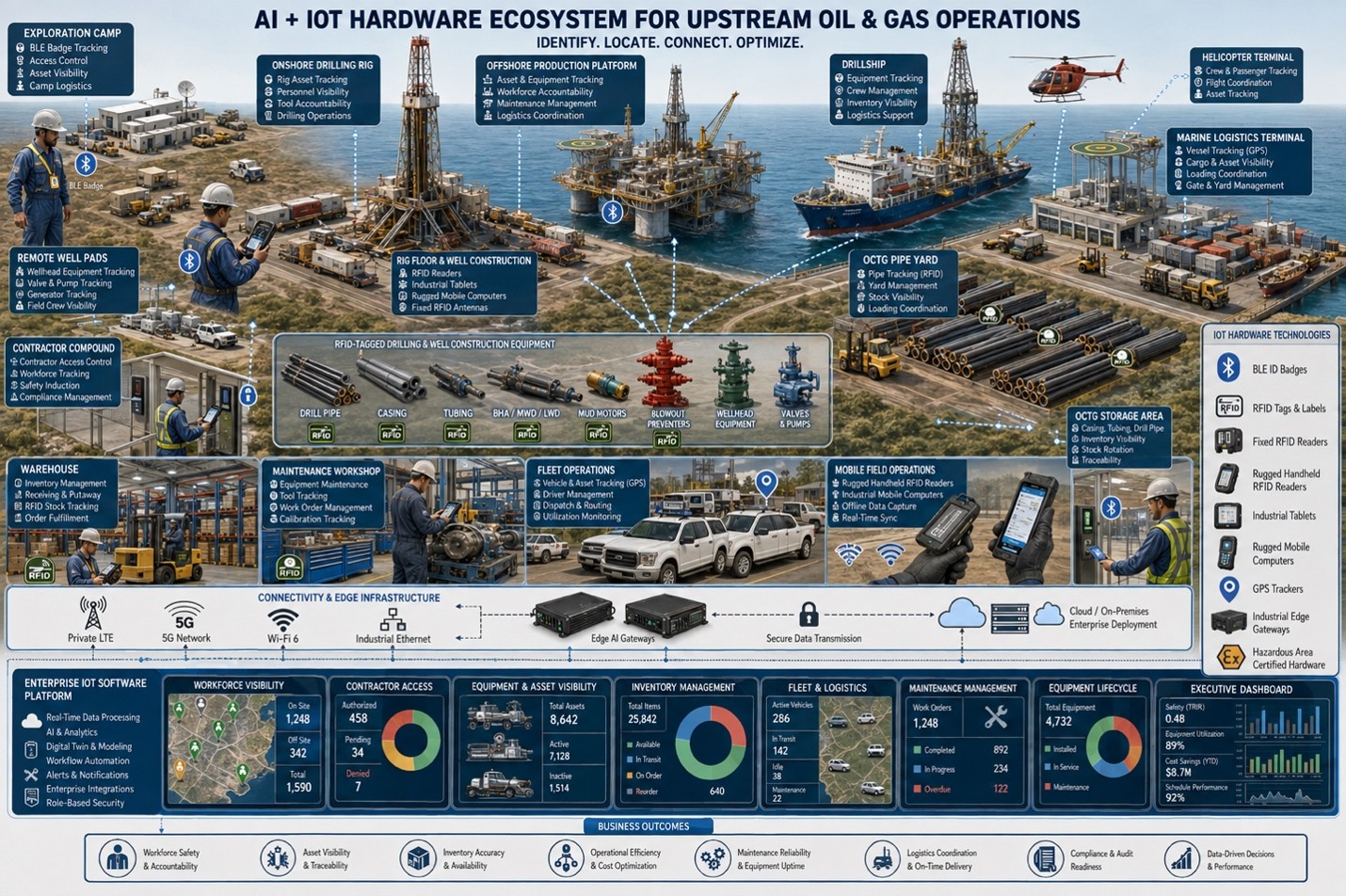
This enterprise illustration showcases the complete AI + IoT hardware ecosystem supporting upstream oil and gas operations, connecting exploration sites, drilling rigs, offshore platforms, logistics hubs, warehouses, maintenance facilities, and field operations. It highlights BLE, RFID, GPS, rugged industrial hardware, Edge AI gateways, and enterprise connectivity technologies enabling workforce accountability, equipment traceability, inventory visibility, logistics coordination, maintenance management, and executive operational oversight.
Multi-Technology Upstream Hardware Layer
Industrial Identification & Sensor Hardware
Reliable industrial identification hardware establishes the digital foundation for AI and IoT deployments across upstream oil and gas operations. Every drilling component, production asset, contractor credential, tubular good, warehouse item, mobile vehicle, and maintenance tool requires a persistent digital identity that remains accurate throughout its lifecycle.
Oilfield Identification Devices
Provides rugged industrial identification devices specifically selected for hazardous-area upstream operating environments, mechanical durability, and extreme temperature resilience.
RFID Oilfield Equipment Identification
Enables rapid, contactless identification of high-value drilling assets without requiring direct visual alignment, replacing manual barcode scanning and paper logs.
BLE Upstream Personnel Identification
Provides dependable personnel identification without disrupting normal work activities, establishing secure digital identities that support workforce accountability and safety.
AI and RFID Upstream Tracking Technologies
Transforms raw identification events into operational decision support. Every equipment movement, inventory transaction, and maintenance activity updates enterprise records.
AI and RFID Drilling Equipment Tracking
Provides continuous visibility into critical drilling assets moving among warehouses, staging yards, offshore supply vessels, and active rig floors.
AI and RFID Downhole Tool Identification
Precision-engineered downhole tools represent some of the highest-value assets in drilling. RFID tracks operating hours, calibration logs, and refurbishment cycles.
AI and RFID Oilfield Inventory Tracking
Automates inventory tracking for OCTG tubulars, drill bits, valves, wellhead hardware, and spare parts across regional warehouses, pipe yards, and remote wellsites.
AI and RFID E&P Asset Lifecycle Tracking
Establishes an end-to-end digital history for critical upstream assets from commissioning through multi-well deployments, repairs, recertification, and decommissioning.
Workforce Location, GPS Telematics & Cellular IoT
Exploration and drilling campaigns depend on continuous coordination between personnel, transport fleets, mobile equipment, and remote well pads. Integrated BLE, GPS, and Cellular hardware ensures uninterrupted operational visibility.
AI and BLE Drilling Workforce Location Systems
BLE identification badges provide automated workforce accountability across drilling floors, mud systems, pipe handling zones, control rooms, accommodation modules, and logistics hubs.
AI and BLE Hazard Zone Personnel Identification
Automatically verifies authorized personnel entering wellhead control areas, BOP testing zones, high-pressure pumping locations, crane zones, hot work areas, and confined spaces.
AI and BLE Offshore Worker Badge Tracking
Offshore facilities require continuous personnel accountability across helicopters, crew transfer vessels, drillships, and offshore production platforms.
AI and BLE Contractor Identification Solutions
Streamlines contractor administration across directional drilling, cementing, wireline, inspection, maintenance, and logistics service providers.
AI and GPS Oilfield Vehicle Tracking Systems
Provides GPS telematics for heavy haul trucks, fuel/water carriers, wireline units, cementing trucks, mobile workshops, and field logistics fleets.
AI and GPS Drilling Equipment Tracking
Continuous location visibility for land drilling rigs, mud systems, cementing units, power generators, mobile camp facilities, and portable cranes.
AI and GPS Remote Wellsite Asset Tracking
Monitors remote wellheads, artificial lift skids, communications trailers, mobile generators, and temporary field offices operating in isolated production basins.
AI and GPS Upstream Field Logistics Tracking
Tracks material consignments: OCTG tubular shipments, drill bit deliveries, completion equipment, fuel distribution, and offshore supply chain movements.
AI and Cellular Upstream Connectivity & Offshore Tracking
Deploys Private LTE, 5G, LTE-M, NB-IoT, and secure industrial gateways for remote wellsites, offshore platforms, supply vessels, and mobile field assets.
Relevant Standards & Regulatory Frameworks
Petrovia AI hardware implementations comply with strict North American and international standards for hazardous locations, industrial wireless communications, cybersecurity, functional safety, and asset traceability.
Relevant U.S. Standards & Regulations
Mandatory federal safety, hazardous area, and industrial communication standards governing oil and gas upstream operations across the United States.
Canadian & Industry Standards
Comprehensive regulatory requirements governing upstream oil and gas, hazardous equipment, worker safety, and API/ISO asset management standards.
Cybersecurity & Global Technology Ecosystem
Because AIoT systems bridge industrial hardware, wireless communications, and operational technology (OT), robust cybersecurity is built in at every layer.
Real-World Upstream Field Case Studies
Proven results from multi-rig drilling campaigns, well construction projects, onshore intervention operations, and oil sands facilities deployed across the United States and Canada.
Houston, Texas, USA — AI and IoT Workforce Accountability, Access Control, and Drilling Asset Visibility for Multi-Rig Operations
A large upstream oil and gas operator managing multiple land drilling rigs across the Permian Basin sought to improve workforce accountability, contractor access management, drilling equipment visibility, and inventory control. Leveraging extensive implementation experience developed through GAO Tek Inc. and GAO RFID Inc., Petrovia AI implemented an enterprise AI and IoT solution combining RFID, BLE, GPS, Edge AI, Private LTE, and Wi-Fi 6.
Key Solution Components & Hardware Integration:
Technical Lesson Learned: Early standardization of RFID tag placement, workforce badge issuance procedures, digital asset naming conventions, and enterprise master data significantly simplified software integration and improved long-term traceability.
Midland, Texas, USA — AI and IoT Asset Tracking, Inventory Management, and Equipment Traceability for Well Construction
A multi-site upstream operator responsible for drilling, well construction, hydraulic fracturing support, and completion activities in West Texas deployed an enterprise AI and IoT system. Combining industrial RFID tags on casing strings, BHAs, completion tools, and pressure pumping fleets with BLE workforce badges and GPS telematic trackers.
Technical Lesson Learned: Long-term success depended on establishing standardized digital asset identities, consistent RFID tagging procedures, structured inventory classifications, and unified integration between ERP, EAM, CMMS, and logistics software.
Bakersfield, California, USA — AI and IoT People Tracking, Access Control, and WIP Visibility for Mature Oilfield Operations
A major upstream operator managing mature oilfields, artificial lift systems, workover rigs, and well intervention programs in California deployed industrial RFID hardware across beam pumping units, wireline trucks, and production tools, combined with BLE workforce badges and Edge AI processing.
Technical Lesson Learned: Consistent workforce identity management, standardized RFID asset registration, and unified digital work order integration proved essential for maintaining accurate Work-in-Progress visibility across geographically dispersed production operations.
Fort McMurray, Alberta, Canada — AI and IoT Workforce Identification, Asset Tracking, and Traceability for Oil Sands Operations
A large upstream oil sands producer operating multiple well pads, gathering systems, central processing support facilities, and warehouses deployed an enterprise AIoT solution utilizing rugged RFID hardware, BLE badges, and GPS tracking across remote oil sands assets.
Technical Lesson Learned: Standardized digital identities for personnel, production equipment, contractor assets, and maintenance inventories provide greater long-term operational value than isolated technology deployments.
Transforming Upstream Operations with Enterprise AIoT Hardware
Exploration and production organizations require more than standalone IoT devices—they need a scalable industrial identification infrastructure that delivers trusted operational data across every phase of the upstream asset lifecycle. From exploration and drilling through completions, production support, maintenance, and decommissioning, enterprise AI and IoT hardware enables continuous visibility into personnel, equipment, inventory, vehicles, and critical operational assets operating in some of the industry's most demanding environments.
Petrovia AI combines rugged RFID, BLE, GPS, Private LTE, 5G, Wi-Fi 6, Edge AI computing, industrial gateways, and secure enterprise integration to establish persistent digital identities that support workforce accountability, asset tracking, inventory management, access control, logistics coordination, work-in-progress visibility, and lifecycle traceability.